Read or listen
Explore text with your screen reader while narration stays paused. Choose a voice and pace when you want audio.

A shared shelf. A voice for every story. Help blind and low-vision students read, listen, and explore pictures—right in their browser.
Already have a school account? Open Teacher access and sign in to manage your classes. Students: join your class.
No student names or emails neededA LITTLE COMPANION. A WHOLE CLASSROOM.
Add a book you have permission to share to your class shelf.
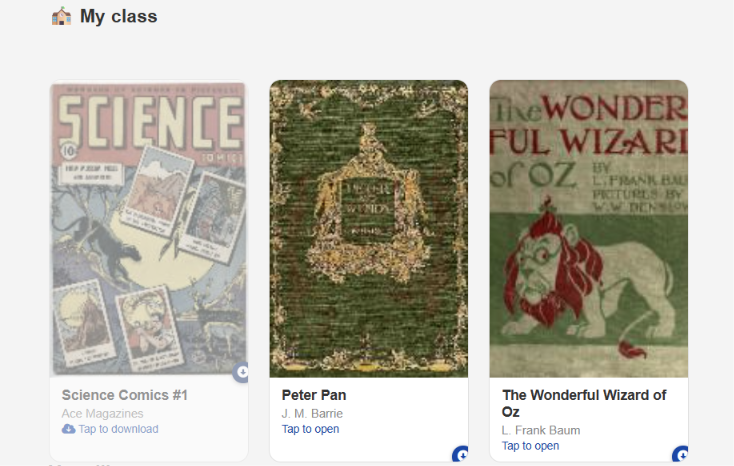
Send a class link. Students join with a seat such as “Reader 1”.
Listen, follow the text, and hear descriptions of the pictures.
Open a short original story without an account. Navigate headings, read a line or a word, and search for a passage with your usual tools. Koby opens the sample paused.
Try a reading sample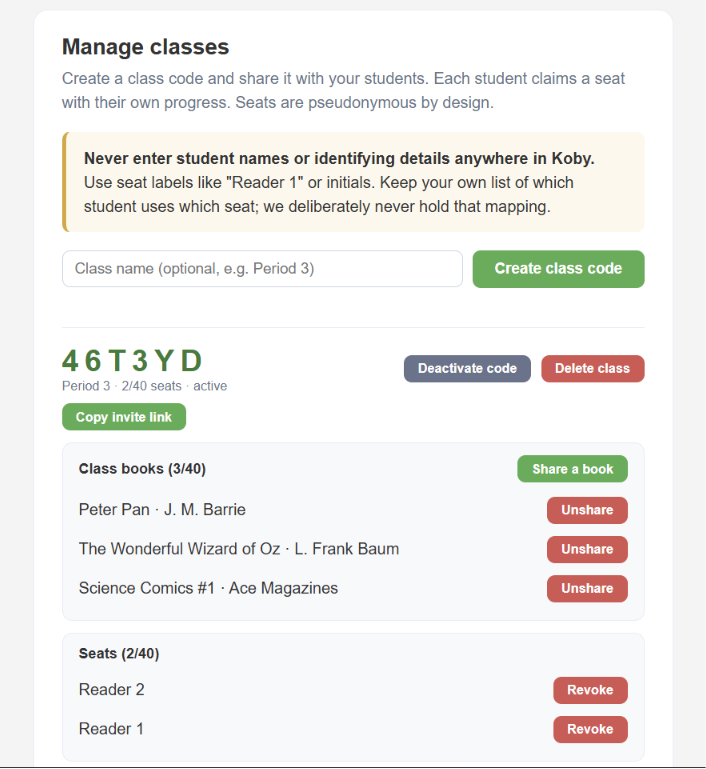
Explore text with your screen reader while narration stays paused. Choose a voice and pace when you want audio.
AI descriptions appear as readable text alongside illustrations, charts, and comic pages. They can contain mistakes.
Study Mode offers questions and feedback. AI features require an internet connection and the appropriate account access.
The reader offers nine interface languages. Narration depends on available voices; translation requires sign-in and internet.
Add a book to your library on this device, then share it from the class manager. Only share material you are authorized to distribute.
An invitation fills in the class code. Students then choose or create their seat, using a label such as Reader 1.
Use DRM-free books your institution has permission to distribute. EPUB and FB2 preserve chapters best; text-based PDFs work better than scans. Koby also supports Word and CBZ/CBR comics. Your institution remains responsible for distribution rights.
Students do not need personal email accounts. Use pseudonyms such as Reader 1; do not enter student names or identifying information in labels, books, or answers. Keep any mapping between seats and students at your school. School accounts disable analytics and public sharing.
Local reading works on the device. Shared books and account progress use Firebase. AI descriptions and Study Mode send relevant content to Google AI services; cloud narration sends chapter text to our audio service. Review the full privacy policy with your institution before using sensitive material.
Reading text, headings, keyboard controls, and search are designed to work with assistive technology. We have tested a focused reading and search journey with NVDA and Chrome. JAWS, VoiceOver, braille displays, and your school’s full workflow still need evaluation on your equipment. Tell us about any barrier you encounter.
Account access, class sharing, new AI descriptions, and cloud generation require internet. Prepare books and audio before going offline, then test reopening them on the devices your students use.
Tell us your school, roughly how many staff members would evaluate Koby, and the reading tasks you want to test. Do not include student information. We will coordinate staff access and evaluation materials with you.
Email the Koby teamOpens your email app. You can also copy this address: luaraiteam@gmail.com.
Pilots are free to evaluate. Staff access is enabled by our team; creating a personal account does not start a school pilot. Institutional pricing is available on request.
Once access is ready: create a class, add a book in the reader, share it to the class, and send the invitation. Students choose or create a seat and reach their class shelf.